Recorded candidate decisions · Jev contract

JevForge

An end-to-end toolkit for decision-data synthesis, training, evaluation and inference, focused on fast decisions inside web interactions — which element to click, navigate to, fill, route or escalate next.

synthesize → train → serve 1 forward pass 0 output tokens Jev contract · /v1/systemone p50 50 ms
0.000
OOD top-1 on websites it never saw
0 ms
warm p50, local GPU — vs 1,078 ms hosted API
0
steps in the recorded release recipe
<0 GPU-h
end-to-end training on one RTX 4090
01 · Demo

Watch it choose, element by element

A live-capable autopilot on a mock travel site. Every control on the page is a real candidate from a recorded Mind2Web annotation. Two cursors work the same page — JevForge in orange, Jev-1.13 in gray — each glides to its own pick and clicks it; the amber ring marks the gold answer, and each verdict lands at its click point. Pages turn like real browsing; it runs all 48 held-out samples on a loop.

connecting to /v1/systemone · sample / 48 ·
FlightCenter — Fall fares JevForge demo
‹ › ⟳ 🔒 https://www.flightcenter.com/deals JevForge— ms Jev-1.13— ms autopilot
Task
FlightCenterFARES·DEALS

    Fall fares: fly warm for less

    Hand-picked round trips under $298 — book by Oct 31 and lock in summer's lowest fares to 40+ sunny cities.

    Today's lowest fares

    Round trip, incl. taxes · updated 4 min ago

    DestinationDatesFare
    ✦ Member Week

    Extra 15% off select Caribbean routes — Nov sailings only.

    © 2026 FlightCenterAboutHelpPrivacyTerms demo surface rendered from recorded DOM candidates

    The complete replay is scaled to the current viewport.

    02 · Speed

    System-One speed, measured

    Same Jev contract, same request — three questions (choice + score + noul) answered per call. JevForge serves them from a local GPU in a single forward pass; Jev-1.13 round-trips a generation API. Lower is better.

    JevForge 0.8B local · RTX 40900 ms
    Jev-1.13 hosted API0 ms

    same contract · 3 questions per request — choice, score and noul answered together in the recorded setup. It does not use autoregressive text decoding.

    0 msmeasured request latency distribution1,200 ms
    p50 50observed max 53

    1 forward pass · 0 output tokens

    The whole answer — a full distribution over candidates, a difficulty score and per-statement truths — is read straight off the logits. No autoregressive decoding, no prompt-injected reasoning or generated answer text.

    21.6× fasterwarm p50 50 ms12 measured calls
    03 · Results

    Held-out, website-disjoint, honest

    Fixed splits — a website never appears in both training and evaluation. Results below are reported as a bounded candidate-scoring comparison; one lower OOD score-MAE row is not a general superiority claim.

    metricsplitRaw Qwen3.5-0.8B¹JevForge 0.8BJev-1.13
    choice top-1 ↑test0.2350.5790.543
    ood0.3400.6370.610
    noul accuracy ↑test0.8260.910
    ood0.8600.825
    noul Brier ↓test0.1280.092
    ood0.1170.131
    score MAE ↓test0.3670.348
    ood0.3900.463

    ¹ Raw backbone = zero-shot JSON scoring on the first 200 records per split. noul = per-statement truth probability; Brier ↓ better; score MAE = mean absolute error of the 0–1 difficulty score.

    04 · Architecture

    One toolkit, the whole decision lifecycle

    JevForge covers the path from raw task records to a calibrated, Jev-compatible service. Its first focus is the repeated decision loop inside web interaction: observe the page state, score the available actions, act, and repeat. The model is one output of that reproducible pipeline, not the whole project.
    01 · DATABuild decision recordsnormalize raw states, questions, candidates and website-disjoint splits
    02 · SYNTHESIZEComplete supervisioncreate auditable decision-label distributions with resumable caches
    03 · TRAINFit and calibratetrain candidate scorers, select checkpoints and calibrate held-out probabilities
    04 · SERVEEvaluate and inferrun frozen test/OOD reports and expose the Jev-compatible endpoint
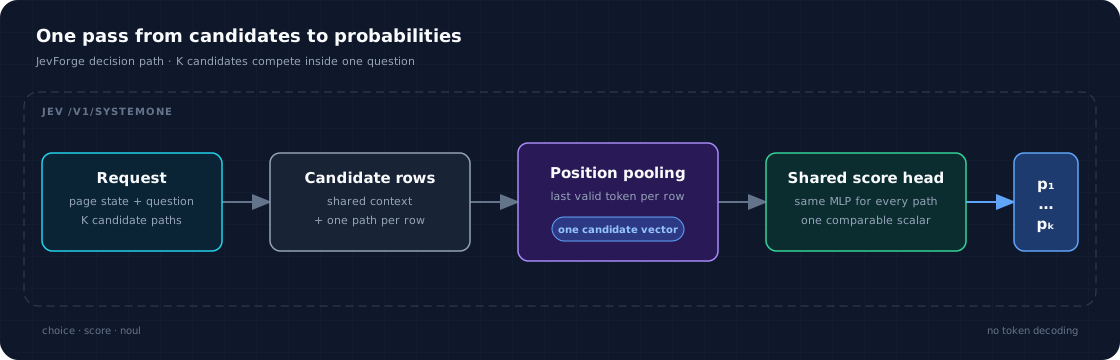
    JevForge candidate scoring: shared context, candidate rows, final-token pooling, shared scorer, question-level probabilities
    Candidate framingshared state + question, paired with one candidate path per row
    Position poolingthe last valid token becomes that candidate's representation
    Shared scorerone two-layer GELU head assigns every candidate a comparable scalar
    Question softmaxonly candidates from the same question compete; no text decoding

    JevForge is a personal, independent research project exploring open structured-decision models and Jev-style interfaces.

    choice

    Which element should I act on?

    A complete probability distribution over every candidate element — click targets, nav items and form fields — with ties and uncertainty preserved.

    score

    How hard is this page?

    A 0–1 difficulty score per task, learned from recorded label distributions so downstream agents can decide when to slow down or escalate.

    noul

    Is this statement true here?

    Per-statement truth probabilities over the page state — graded belief instead of a brittle boolean, so "maybe" survives the contract.

    05 · Tutorial

    Install and serve in three steps

    Everything runs locally: weights from Hugging Face, an OpenAI-style endpoint on your own GPU, and the exact Jev contract your agents already speak.

    1

    Install

    Clone the repo and install dependencies (Python 3.11+).

    git clone https://github.com/zwliJay/jev-forge.git \
      && cd jev-forge \
      && pip install -r requirements.txt
    2

    Download weights

    Pull the trained checkpoint from Hugging Face.

    huggingface-cli download \
      AndeyTait/JevForge-0.8B \
      --local-dir ckpt
    3

    Serve & call

    Start the Jev-compatible server, then ask it anything.

    python -m jevforge.serve \
      --checkpoint-dir ckpt \
      --port 8123
    # Jev contract in, probabilities out
    curl localhost:8123/v1/systemone \
      -H 'content-type: application/json' \
      -d '{"state":"Task: open the privacy
        settings page. Elements: [e1] link
        Settings, [e2] button Submit, [e3]
        link Privacy","questions":{
          "next":{"type":"choice",
            "instructions":"Which element
            should be interacted with next?",
            "criteria":{"e1":"link Settings",
              "e2":"button Submit",
              "e3":"link Privacy"}},
          "is_link":{"type":"noul",
            "instructions":"e1 opens the
            privacy settings."}}}'
    🛠 Train your own — the whole assembly line

    Three entry points take you from raw pages to a served model. Or run scripts/run_web_pipeline.sh for all of it in one shot.

    # 1 · Mind2Web → Jev-contract decision records, website-disjoint splits
    python -m jevforge.build_web
    # 2 · complete missing decision labels — streaming, resumable cache
    python -m jevforge.synthesize
    # 3 · CE + Brier on complete candidate sets, cosine LR, temperature calibration
    python -m jevforge.train
    Preliminary RLCD path Starting from the supervised 0.8B checkpoint, JevForge updates complete candidate distributions with task utility + multiclass Brier reward + reference-policy KL. Grouped sampling uses a within-group reward baseline; browser hard-negative views keep every gold action and add confusable candidates only to training. The plain run moved choice top-1 from 57.87% to 58.75% on test and 63.73% to 64.25% OOD; one hard-negative view reached 64.77% OOD. The general supervised checkpoint remains the release default because ordered-score quality trades off in this first sweep. Results and method ↗
    ⚡ Recorded v1 recipe: 1,200 steps on one RTX 4080 SUPER. Reproduction time and cost depend on hardware and label-provider availability.